YTMDP-1200/2+2+10 Ceramic Tile Bevel Edge Polishing Machine
Ceramic tile 45 degree bevel edge polishing machine completes squaring, chamfering and polishing in one pass for smooth, consistent edges in batch production.
Product introduction
YTMDP-1200/2+2+10 at a Glance
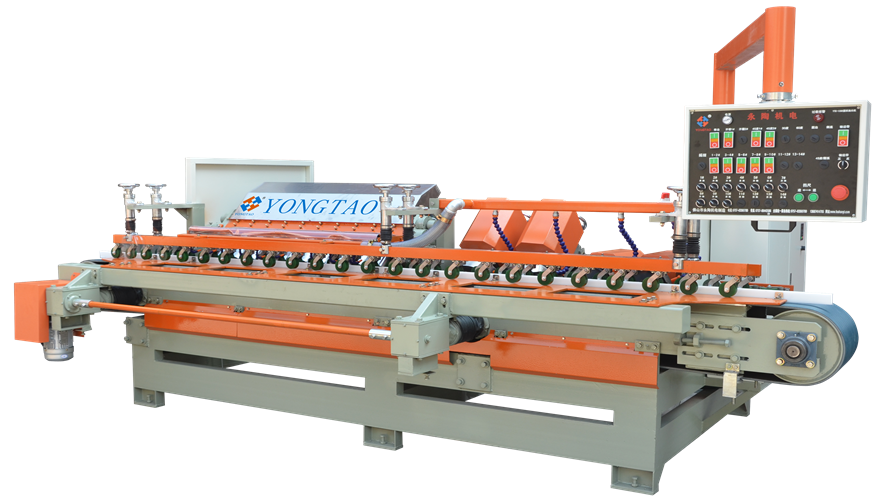
The YTMDP-1200/2+2+10 is a ceramic tile 45 degree bevel edge polishing machine developed for continuous processing of ceramic tile edges. It combines two squaring heads, two fixed 45° chamfering heads and ten polishing heads in one machine, allowing one selected tile edge to be calibrated, beveled and progressively polished during a single conveyor pass.
The machine processes ceramic tiles from 100 to 1200 mm wide and 6 to 20 mm thick. Its working speed is adjustable from 3 to 9 m/min, enabling operators to match the conveyor speed to the tile specification, incoming edge condition, bevel depth and required surface finish.
This configuration is designed for factories and ceramic tile processing workshops that repeatedly process tiles of the same specification. Continuous feeding reduces manual transfer between separate squaring, chamfering and polishing operations while supporting stable batch production.
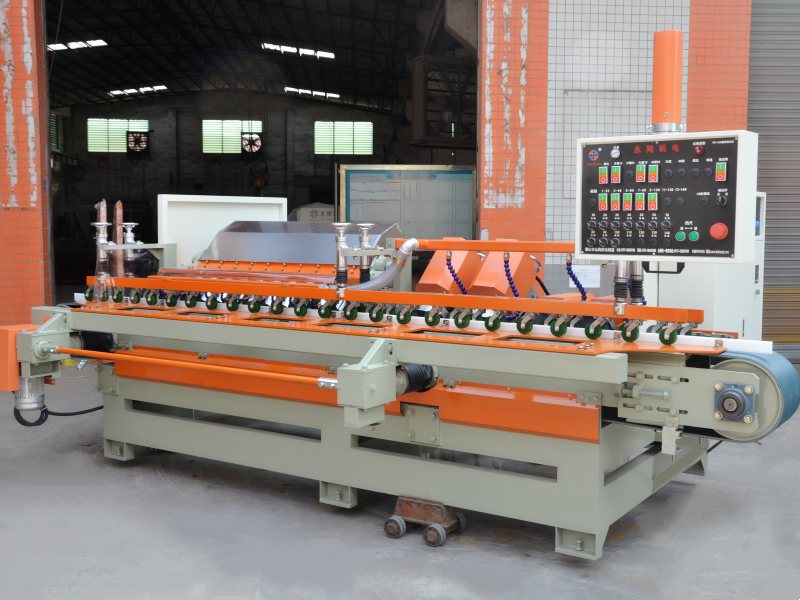
Front view of the YTMDP-1200/2+2+10 showing the conveyor, pressure wheels and operator control panel.
How the 2+2+10 Head Layout Works
The 2+2+10 configuration identifies the number and function of the processing heads installed along the conveyor.

Rear structure of the YTMDP-1200/2+2+10 showing the squaring, 45° chamfering and polishing head arrangement.
Two Squaring Heads
Two 200 mm squaring wheels prepare the selected ceramic tile edge before chamfering. They remove edge irregularities and establish a straighter reference surface so that the following chamfering heads can form a more consistent bevel.
Correct squaring is important when the incoming tile edge has small dimensional variations, chips or cutting marks. The squaring depth should be set according to the original edge condition rather than removing unnecessary material.
Two Fixed 45° Chamfering Heads
After squaring, the tile passes through two 200 mm chamfering wheels. These heads progressively form the required 45° bevel.
The chamfering stations use a fixed-angle structure. The operator adjusts the grinding depth to control the bevel rather than changing the working angle. This arrangement is suitable for repeated production requiring a consistent 45° ceramic tile edge.
Ten Progressive Polishing Heads
Ten 125 mm polishing heads refine the beveled surface after chamfering. The abrasive sequence progressively removes grinding marks and improves the smoothness and appearance of the finished edge.
Wheel and abrasive selection should be matched to the ceramic tile body, glaze, bevel depth and required finish. Sample processing is recommended before starting continuous production with a new tile specification.
Built for Stable Ceramic Tile Handling
Stable tile positioning is essential when processing large-format ceramic tiles. The YTMDP-1200/2+2+10 uses PU pressure wheels to hold the tile during conveyor feeding. PU material provides wear resistance while helping maintain controlled contact with the tile surface.
A dual tile-support structure is provided for large-size processing. These supports help reduce tile tilting as wider pieces enter and pass through the squaring, chamfering and polishing stations. Correct support positioning is especially important when using the machine as a large-format ceramic tile bevel edge polisher.
The processing width can be adjusted up to 1200 mm. The width-adjustment arrangement allows operators to prepare the machine for different tile sizes without repeatedly dismantling the guide structure.
Control, Protection and Daily Operation
The machine is designed to make routine adjustment and production control straightforward.
The movable control box can be positioned for convenient operation and observation.
Frequency-conversion speed control provides an adjustable working range of 3–9 m/min.
Each motor and pneumatic cylinder has an independent control button.
PU pressure wheels provide stable tile contact and a long operating life.
Dual supports improve the feeding stability of large-format tiles.
The fixed 45° chamfering structure simplifies angle control during repeated production.
Stainless steel water covers help prevent polishing water and slurry from entering the motors.
The 300 mm conveyor belt carries the tile through all processing stations continuously.
Individual head controls make inspection, setup and maintenance more convenient.
The operator should confirm water flow, air pressure, wheel condition, guide position and conveyor movement before starting each production batch.
Suitable Ceramic Tile Products and Applications
The machine is intended for compatible ceramic tiles that require a polished 45° edge. Typical applications include:
Ceramic wall tile bevel polishing
Ceramic tile components prepared for external corner assembly
Decorative ceramic tile edge finishing
Repeated processing of one selected tile edge
Ceramic tile components requiring edge squaring before chamfering
Batch production of tiles with a consistent bevel specification
Large-format ceramic tile edge finishing
Ceramic tile factory bevel polishing operations
As a ceramic wall tile bevel polishing machine, the YTMDP-1200/2+2+10 can prepare compatible wall tile components for finished corner details. As a ceramic tile external corner bevel machine, it forms and polishes the angled edge used before assembly.
Tile samples should be tested when the material has an unfamiliar body composition, surface coating or glaze. Testing helps confirm the correct wheel specification, abrasive sequence, feed speed and bevel depth.
Continuous Ceramic Tile Bevel Processing
The YTMDP-1200/2+2+10 works as a continuous-feed ceramic tile bevel edge polisher. The processing sequence is completed as follows:
1. Tile Positioning
The ceramic tile is placed on the conveyor with the selected edge aligned against the machine reference. The guide and pressure-wheel positions are checked according to tile width and thickness.
2. Edge Calibration
The two squaring heads remove irregularities and establish a stable reference edge. Squaring depth should be sufficient to prepare the edge without excessive material removal.
3. Fixed 45° Chamfering
The two chamfering heads progressively grind the calibrated edge to the fixed 45° angle. Grinding depth is adjusted according to the required bevel size.
4. Progressive Bevel Polishing
The ten polishing heads refine the chamfered surface through the selected abrasive sequence. Correct abrasive arrangement helps remove grinding marks gradually rather than attempting to achieve the final finish with one polishing stage.
5. Finished-Edge Inspection
The operator checks bevel width, edge straightness, surface smoothness and visible defects. Machine settings should be confirmed with sample tiles before full batch production begins.

Smooth 45° bevel edge produced on a ceramic tile by the YTMDP-1200/2+2+10 bevel edge polishing machine.
This integrated process gives the machine the functions of a ceramic tile edge squaring and bevel polishing machine without requiring manual transfer between the three main processing stages.
Technical Data
Actual output and finished-edge quality depend on the tile body, glaze condition, incoming edge quality, bevel depth, abrasive selection, wheel condition and operating speed.
Specifications may be adjusted according to the required electrical standard and confirmed production configuration. Final utility requirements should be verified before manufacturing and installation.
Before Starting a Production Batch
For stable processing, operators should complete the following checks:
Confirm the Tile Specification
Record the tile material, width, length and thickness. Confirm which edge will be processed and how the finished tile will be assembled.
Inspect the Incoming Edge
Check for chips, uneven cutting marks and dimensional variation. The incoming condition determines how much squaring is required before the bevel can be formed.
Set the Guide and Supports
Adjust the reference guide, pressure wheels and dual supports to hold the tile steadily. Wider tiles require correct support to prevent tilting during feeding.
Adjust the Bevel Depth
The chamfering angle is fixed at 45°. Set the grinding depth according to the required bevel width and finished corner design.
Select the Abrasive Sequence
Choose compatible squaring wheels, chamfering wheels and polishing abrasives. The sequence should progress from material removal to surface refinement.
Set the Working Speed
Use the frequency converter to select an appropriate speed within the 3–9 m/min range. A suitable setting depends on tile condition, bevel depth and finish requirements.
Run Sample Tiles
Process sample pieces and inspect the complete edge before continuous production. Record confirmed settings when the same tile specification will be processed repeatedly.
When to Select the YTMDP-1200/2+2+10
This model is suitable when your production requires:
A 2+2+10 ceramic tile bevel edge polishing machine
A fixed 45° bevel rather than an adjustable-angle profile
Processing widths from 100 to 1200 mm
Ceramic tile thicknesses from 6 to 20 mm
A working speed adjustable from 3 to 9 m/min
One-edge processing during each conveyor pass
Integrated squaring, chamfering and polishing
Repeated batch processing of consistent tile specifications
Stable support for large-format ceramic tiles
Independent control of motors and pneumatic cylinders
Before ordering, provide the tile dimensions, thickness, incoming edge condition, required bevel depth, finished-edge standard, production target and local electrical specification. Tile samples or clear edge drawings can help confirm the appropriate wheel and abrasive configuration.
Frequently Asked Questions
What does 2+2+10 mean?
The configuration includes two squaring heads, two fixed 45° chamfering heads and ten polishing heads. The three head groups prepare, form and refine one selected ceramic tile edge during continuous conveyor feeding.
Is this a 45 degree ceramic tile beveling machine?
Yes. The machine squares the incoming edge, forms a fixed 45° bevel and progressively polishes the beveled surface. The bevel depth can be adjusted according to the required finished edge.
Can it complete squaring, chamfering and polishing in one pass?
Yes. One selected edge passes continuously through the squaring, chamfering and polishing stations. The tile does not need to be manually transferred between separate machines for these three stages.
Does the machine process one edge or both edges simultaneously?
The YTMDP-1200/2+2+10 is a single-edge ceramic tile bevel polishing machine. It processes one selected edge during each pass. The tile must be repositioned and fed again when another edge requires the same finish.
What ceramic tile sizes can it process?
The listed processing width is 100–1200 mm, and the supported thickness is 6–20 mm. Tiles must also be suitable for stable conveyor feeding and correct pressure-wheel positioning.
Is it suitable for large-format ceramic tiles?
Yes. The maximum processing width is 1200 mm, and the machine uses dual supports to help stabilize wider tiles. Correct support, guide and pressure-wheel adjustment is required before processing large-format pieces.
What is the production speed?
The adjustable working speed is 3–9 m/min. Actual output depends on tile size, bevel depth, incoming edge condition, abrasive selection, required finish and the number of edges processed on each tile.
Can the 45° angle be changed?
The chamfering stations use a fixed 45° structure. The operator adjusts the grinding depth to control the bevel size; the processing angle itself is not designed for routine adjustment.
What products can be made with this machine?
Typical applications include ceramic wall tile edge finishing, external corner components, decorative beveled pieces and repeated batches requiring a consistent polished 45° edge.
What utilities are required?
The listed requirements include 22.45 kW of installed power, approximately 50 L/min of compressed air and 490 L/min of water. The final electrical voltage, frequency and phase should be confirmed before manufacturing.
How are polishing wheels and abrasives selected?
Selection depends on the ceramic body, surface glaze, incoming edge condition, bevel depth and required finish. Sample processing is recommended before confirming the production abrasive sequence.
What information is needed for a quotation?
Please provide the ceramic tile material, minimum and maximum dimensions, thickness, required 45° bevel depth, finished-edge requirement, expected production capacity, local voltage and available factory space.
Compare Other Tile Beveling Configurations
Compare other head configurations, processing ranges and production requirements in Yongtao’s Tile Beveling Machine category.
Machine specifications
| Item | Specification |
|---|---|
| Model | YTMDP-1200/2+2+10 |
| Conveyor belt width | 300 mm |
| Number of squaring heads | 2 |
| Squaring wheel diameter | 200 mm |
| Number of 45° chamfering heads | 2 |
| Chamfering wheel diameter | 200 mm |
| Chamfering motor power | 3 kW |
| Number of polishing heads | 10 |
| Polishing wheel diameter | 125 mm, Y3 type |
| Speed adjustment | Frequency conversion |
| Processing width | 100–1200 mm |
| Processing thickness | 6–20 mm |
| Working speed | 3–9 m/min |
| Total installed power | 22.45 kW |
| Approximate electricity consumption | 22 kWh per operating hour |
| Air consumption | 50 L/min |
| Water consumption | 490 L/min |
| Machine dimensions | 4300 × 2200 × 2000 mm |
| Machine weight | Approximately 3500 kg |
Technical data reflects the legacy product record. Confirm voltage, options and final configuration with the approved quotation.
Bring the material. We’ll plan the process.
Send your material, maximum dimensions and production target. We will help you confirm the suitable machine configuration.